
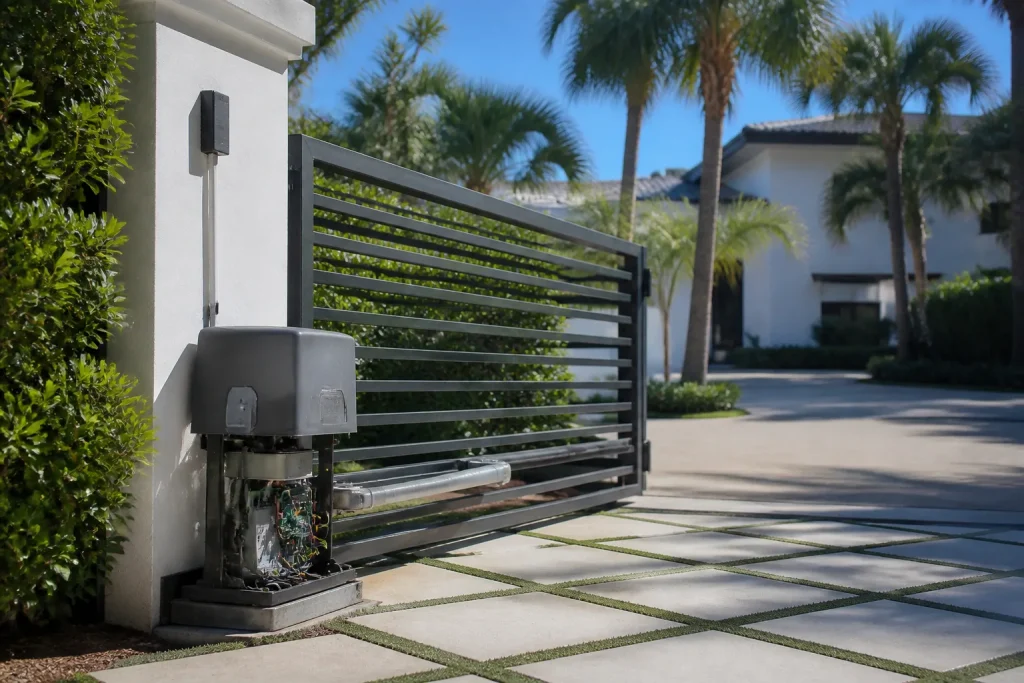
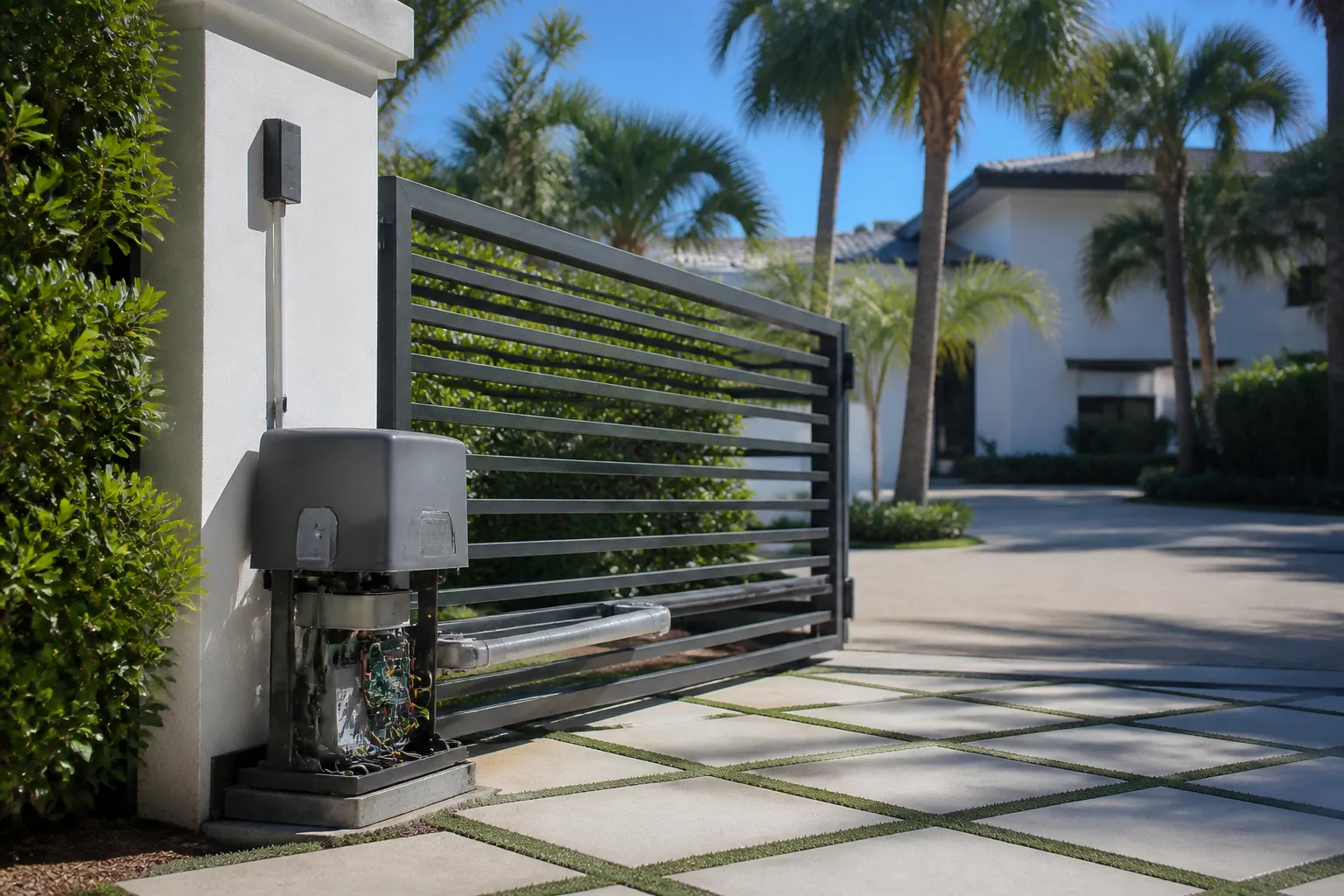
Ghost Controls Gate Repair in Miami: A Homeowner’s Guide
Ghost Controls gate repair in Miami usually comes down to one of three things: a corroded battery terminal, a solar panel that isn’t keeping up with the gate’s actual cycle load, or limit switches that have drifted out of calibration. The good news is that most Ghost Controls failures we see in Miami are repairable in a single visit, and rarely require a full board replacement. If you’d rather not spend your Saturday with a multimeter, call (833) 570-5807 and we’ll sort it out.
Ghost Controls is one of the most DIY-installed gate operators in South Florida, which means it’s also one of the most DIY-misdiagnosed. Homeowners follow the generic troubleshooting guide, replace the battery, and when the gate still won’t move, they assume the control board is dead. About half the time, it isn’t. It’s a corroded connector or an undersized solar panel that never had a chance against a Miami winter’s short, cloudy days.
The problem with most generic Ghost Controls advice online is that it’s written for a national audience. What works in Arizona doesn’t hold up in Miami’s humidity, salt air, and December cloud cover. This guide covers the failure modes we actually see when we get called out to Ghost Controls systems across Miami, from Pinecrest to Palmetto Bay to the acreages west of Krome Avenue.
Key Takeaways:
– Most “dead” Ghost Controls systems in Miami are power issues, not control board failures
– Miami’s December-January sun angle and cloud cover routinely underpower the stock solar panels
– Salt-air corrosion on battery terminals follows a predictable sequence you can catch early
– Limit switch drift after a gate bump is a calibration fix, not a parts replacement
– Third-party keypads often fail silently on Ghost Controls wiring logic
Why Ghost Controls Solar Charging Falls Short in Miami Winters
Ghost Controls markets their solar kits as a low-maintenance, no-trenching solution, and in most of the country that’s true. But Miami’s dry season, which runs November through April, throws a wrench into those calculations.
The stock solar panel on most Ghost Controls kits is sized for an average of 10 to 15 gate cycles per day under full sun. That’s fine in theory. But Miami’s winter sun angle is significantly lower than summer, which already reduces panel output. Then add the cloud cover that rolls through the dry season, especially during December and January cold fronts, and your panel might only be delivering 40 to 50% of its rated wattage.
Here’s what this looks like in practice. A homeowner in the Redland has a Ghost Controls unit powering a 12-foot tube gate. During summer, it runs perfectly. Come December, the gate starts moving slower, then stops mid-cycle, then stops responding entirely. The homeowner assumes the motor is shot. What’s actually happening is the battery is slowly draining deeper each night because the panel isn’t replenishing it during the day.
Calculating whether your panel can keep up is straightforward. Every open-and-close cycle draws current from the battery. Each Ghost Controls model has a rated current draw per cycle, and your battery has an amp-hour rating. Add up your daily cycles, factor in the reduced winter solar input, and you can see the deficit. If your gate does 20 cycles a day on a panel sized for 12, you’re running a deficit that will kill the battery within two to three weeks.
The fix isn’t always a bigger panel. Sometimes it’s adding a second panel in parallel, sometimes it’s switching to a hardwired AC transformer for the rainy months, and sometimes it’s simply adding a larger battery. The right answer depends on your gate’s actual cycle count, which most homeowners have never measured.
The Corrosion Sequence: Salt Air and Ghost Controls Battery Terminals
Miami’s coastal humidity does a number on every gate operator, but Ghost Controls units have a specific vulnerability in their battery compartment. The terminals and ring connectors are made of standard tin-plated copper, which is fine in most climates. In Miami, the combination of salt air and the constant condensation inside the battery box creates a green-white crust on the terminals within eight to twelve months of installation.
The sequence is predictable. First, you get light oxidation on the negative terminal. The gate still works, but the battery isn’t charging as efficiently. Next, the corrosion spreads to the positive terminal and the ring connectors. Now the gate starts behaving erratically, opening halfway, not responding to remotes, or beeping with error codes. Finally, the corrosion creates enough resistance that the system can’t pull the current it needs to move the gate at all. That’s when most people call us.
The good news: this is almost always repairable without replacing the battery or the board. The procedure is to disconnect power, remove the battery, clean the terminals and ring connectors with a wire brush or fine sandpaper until they’re bright, apply a corrosion inhibitor like dielectric grease, and then seal the battery box properly. On units we service in Coral Gables and Coconut Grove, where salt spray is a constant, we also recommend repositioning the battery box to reduce condensation exposure.
Here’s what you should check:
– Remove the battery box cover and look for any green or white powder on the terminals
– Check whether the ring connectors are loose or have visible corrosion creeping up the wire
– Inspect the battery box gasket, if your model has one, for cracking or gaps
– Feel whether the battery is unusually warm, which indicates internal resistance from poor connections
If you catch this early, you avoid a cascade that eventually damages the charging circuit on the board. Wait too long, and the inconsistent voltage starts stressing the control board, which can lead to a genuine board failure.
Limit Switch Drift: The Bump Problem and How to Recalibrate
Ghost Controls operators use magnetic limit switches to tell the control board where the gate is in its travel. On most residential models, these are small sensor assemblies mounted on the actuator arm or on the gate bracket itself. They’re precise when installed correctly, but they drift.
The most common cause we see in Miami is physical bumping. A palm frond falls on the gate, a delivery truck taps it while backing up, or a kid rides a bike into it. The gate doesn’t need to be damaged to throw off the limit calibration. A shift of even half an inch in the bracket geometry changes where the magnetic sensor reads the stop point.
The symptom is usually that the gate opens too far and the arm binds at the end of travel, or it stops a few inches short of the closed position, leaving a gap. Sometimes it reverses immediately after closing, which confuses the logic because the board thinks it hit an obstruction.
Recalibration varies by model generation:
– Older Ghost Controls models (pre-2018): limit position is set mechanically on the arm with adjustment collars. You loosen the collar, move it to the correct stop point, and retighten.
– Current generation: limits are set through the smartphone app or the onboard programming button. The procedure is to put the gate in limit-set mode, drive it to the open limit manually, set the point, then drive it to the closed limit and set that point.
– After any recalibration: run the gate through at least three full cycles and watch the stop points. If they’re inconsistent, the issue isn’t limits, it’s the arm geometry or a worn gear.
One thing we regularly find in Miami is that the bracket screws on tube gates work loose over time because the gate’s daily thermal expansion and contraction acts like a ratchet. We check and re-tighten bracket hardware on every Ghost Controls service call, and we use thread locker on the critical fasteners so the calibration doesn’t drift again within a few months.
Board Replacement vs. Wiring and Power Issues: Knowing the Difference
This is the part where Ghost Controls owners lose money. The control board is the most expensive single component in the system, and there are plenty of situations where a homeowner or a generalist handyman will condemn the board when the real problem is a ten-dollar fix.
Here’s what tells us the board is actually bad:
– The system shows no lights at all when connected to a known-good battery with clean terminals
– The board emits a burning smell or has visible scorched components
– The system resets randomly even when power is stable
– One function works (like the remote receiver) while another doesn’t (like the motor drive output)
Here’s what often gets misdiagnosed as a bad board but isn’t:
– Corroded battery terminals, as covered above. Clean them first.
– A blown inline fuse on the battery lead or the solar panel lead. We see this constantly, and it’s a two-dollar part.
– A failed battery that’s showing full voltage but collapses under load. A multimeter reading isn’t enough; you need to load-test it.
– A remote that’s lost its programming, which makes the gate appear dead even though the board is fine.
– A photo eye sensor that’s misaligned or dirty, which can make the board think there’s an obstruction.
Our approach at Miami Gate Company is to eliminate the cheap causes first, in order, before we ever recommend a board replacement. That isn’t just cost-conscious, it’s just good diagnosis. We’ve seen too many Ghost Controls boards get swapped out by someone who never checked the fuse or cleaned the terminals, and the new board fails the same way a month later because the underlying power issue was never addressed.
Third-Party Keypads and Intercoms: The Proprietary Wiring Problem
This is the issue nobody warns you about until you’ve already bought the part. Ghost Controls systems use a proprietary communication protocol between the control board and their accessories. Their keypads, remotes, and exit sensors talk to the board in a specific way that isn’t simply a dry contact closure.
So when a Miami homeowner buys a generic keypad from a big-box store or a random intercom from Amazon and wires it into the Ghost Controls board, one of two things happens. Either the accessory simply doesn’t work at all, or worse, it works intermittently and causes the gate to behave unpredictably.
The intermittent failure is the dangerous one. A generic keypad might work fine when the gate is in direct line of sight, but then fail when there’s RF interference or when the temperature shifts. The homeowner can’t figure out why the gate sometimes opens and sometimes doesn’t. They start blaming the board, the battery, the remote, everything except the accessory they spliced in themselves.
Ghost Controls accessories are designed to work together as a system. Their keypads, push buttons, and vehicle sensors all go through the board’s accessory port or a dedicated input, and the wire runs matter. If you’ve added a third-party accessory to a Ghost Controls system and the gate has been acting unpredictably since, disconnect that accessory and see if the behavior returns to normal. In most cases, it does.
If you need a keypad or intercom that isn’t a Ghost Controls brand, there are integration options that work, but they require the correct interface module and the right wiring logic. This is one area where brand-agnostic experience pays off. We work across Mighty Mule, LiftMaster, FAAC, and BFT systems, so we know what plays nicely with Ghost Controls and what doesn’t, and we can recommend an option that won’t introduce gremlins into your system.
When to call a pro: if you’ve checked the battery terminals, confirmed the fuse is intact, and the gate still won’t move, you’re probably past the point where a weekend of YouTube research is going to help. Ghost Controls systems are simple in principle, but the failure modes compound quickly. What starts as a bad terminal becomes a damaged charging circuit, which becomes a dead board and a larger repair bill than necessary.
*Related services in Miami: we handle Ghost Controls repair, electric gate repair at the component level, and full gate installation. If you’re in Boca Pointe, our Gate Repair in Boca Pointe page covers that area, and our Electric Gate Repair in Boca Pointe service handles control boards, sensors, and wiring for all major brands.*
The Bottom Line
Ghost Controls systems are solid operators when they’re set up correctly, but Miami’s climate exposes weaknesses that generic troubleshooting guides don’t address. Your first move when the gate acts up should be checking power, not assuming the board is dead. Clean the battery terminals. Check the fuse. Verify your solar panel is actually charging during winter. Recalibrate the limits if the gate has taken a bump. And if you’ve added a third-party accessory, unplug it and see if the problem goes away.
If you run through those and the gate is still giving you trouble, call a gate specialist who knows the brand. You don’t need to replace a perfectly good Ghost Controls system just because a wire is corroded or a fuse blew. The right diagnosis saves you hundreds of dollars in unnecessary parts. If you’re in Miami and need help, Miami Gate Company offers free estimates, call (833) 570-5807. We work on virtually any gate system, including Mighty Mule, LiftMaster, FAAC, and BFT, and we’ll tell you honestly whether your Ghost Controls unit is worth repairing or if replacement makes more sense.
Frequently Asked Questions
How much does Ghost Controls gate repair cost in Miami?
Ghost Controls gate repair in Miami typically runs between $150 and $350 for common issues like battery replacement, terminal cleaning, limit recalibration, or fuse replacement. More involved repairs, like control board replacement or solar panel upgrades, run higher. The exact price depends on what we find when we diagnose the system, and we always quote the repair before any work starts.
Why does my Ghost Controls gate work sometimes, but not others?
Intermittent operation on a Ghost Controls system in Miami almost always points to a power issue. It could be a battery that’s failing under load, a solar panel that isn’t charging consistently during cloudy stretches, or corrosion on the battery terminals that creates variable resistance. It can also be a third-party accessory that’s interfering with the communication between the remote and the control board.
Can you repair a Ghost Controls gate the same day in Miami?
In most cases, yes. The majority of Ghost Controls issues we see are electrical problems that can be diagnosed and repaired in one visit. Parts like batteries, fuses, and terminals are standard items we carry. If a special-order part is needed, we’ll let you know upfront before scheduling.
Is it better to repair a Ghost Controls system or replace it?
If your Ghost Controls system is less than seven or eight years old and the gate itself is still in good shape, repair almost always makes sense. The components that fail, batteries, terminals, fuses, limit sensors, are all replaceable at a fraction of the cost of a new operator. Replacement becomes the better call when the board has failed and the arm is also worn, or when the gate’s cycle load has increased beyond what the current system was designed for.
Do you work on other gate brands besides Ghost Controls?
Yes. We service nine major gate and operator brands, including LiftMaster, FAAC, BFT, DoorKing, Viking, Linear, Elite, and Mighty Mule, in addition to Ghost Controls. We’re brand-agnostic, so our recommendation is based on what your specific system needs, not what we have in stock.
*We welcome you to visit our Miami Gate Company home page to learn more about our services, or check our Gate Installation in Boca Pointe page if you’re considering a full system replacement. Gates are all we do, and that focus shows in the diagnosis.*
Written by the team at Miami Gate Company, serving Miami since 2012.
Need Gate Repair Help?
Call Miami Gate Company — licensed & insured, here with fast after-hours help in Miami.
(833) 570-5807