
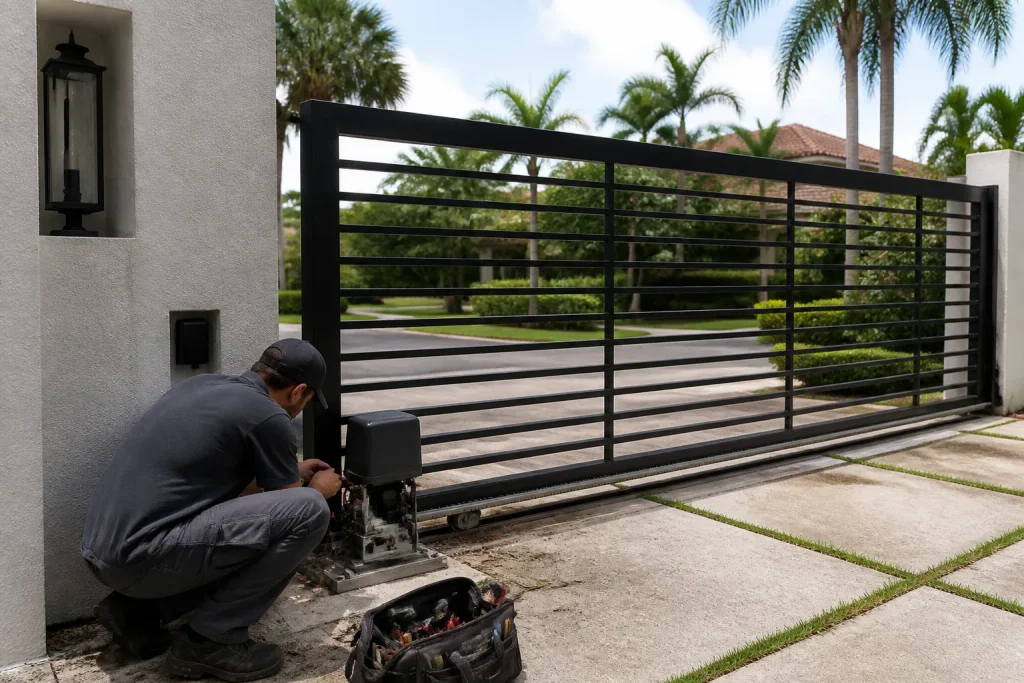
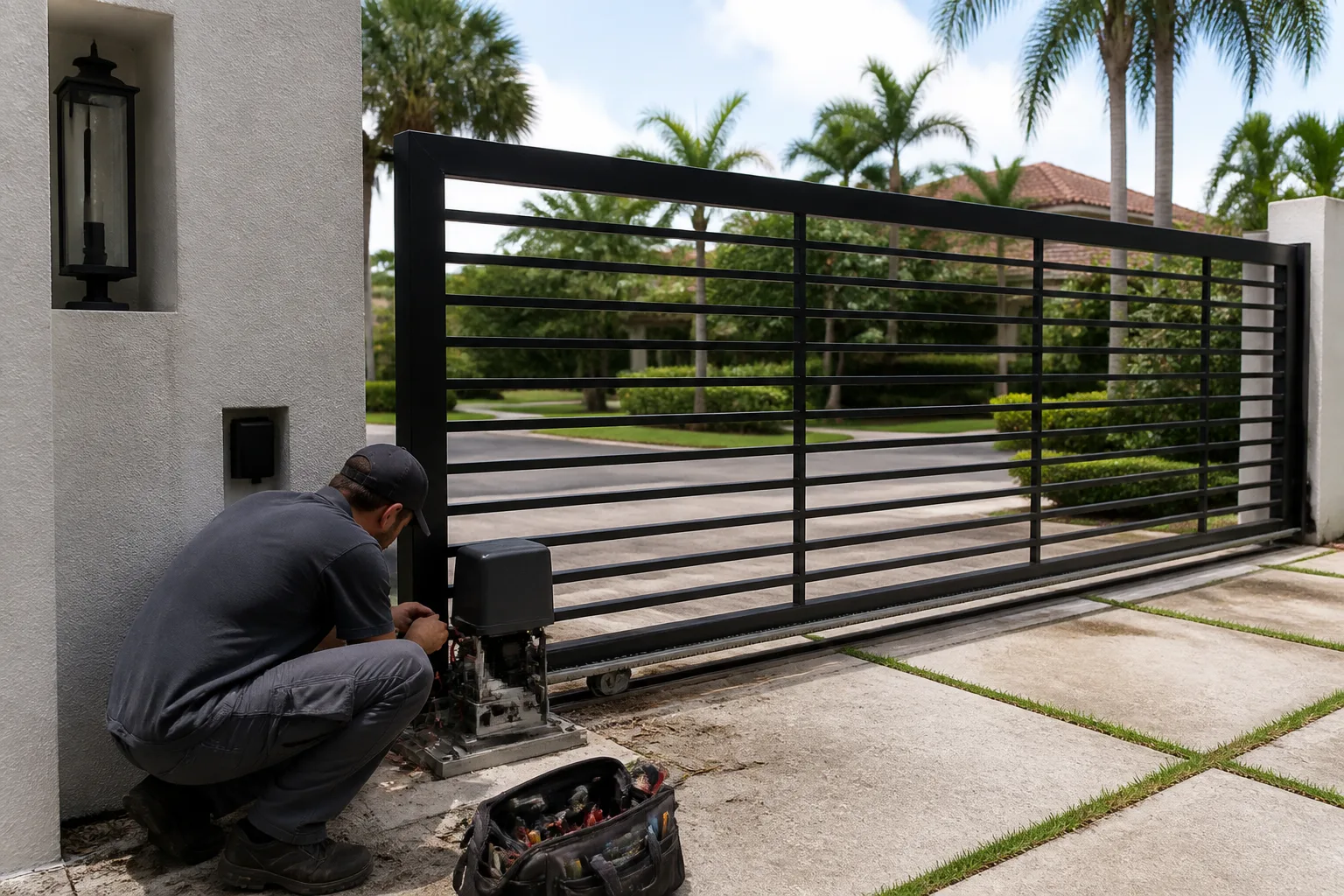
Emergency Gate Repair Near Me: What Miami Homeowners Should Do First
When your gate fails, the first 30 minutes matter more than most people realize. What you do before a technician arrives can either protect your system or turn a simple fix into a full operator replacement. Here’s the short version: stop forcing the gate, kill power only if it’s safe to do so, secure the opening, and call a gate specialist who asks about your operator brand before quoting. If you’d rather not deal with any of it, call (833) 570-5807 and we’ll walk you through it.
We’ve seen the same scene play out across Miami dozens of times: a homeowner in Coral Gables or Kendall hears the gate grinding, panics, and cranks the manual release the wrong way. By the time we arrive, a $200 sensor fix has become a $1,200 drive gear replacement. This guide covers what to do in those first minutes so that doesn’t happen to you.
First, Stop Forcing the Gate
The instinct when a gate stops mid-cycle with your car halfway through is to push it. Don’t. On a ram or articulated arm operator, forcing the gate manually without disengaging the clutch can shear the drive gear internally. That’s the difference between a quick sensor realignment and replacing the entire operator head.
Here’s the thing about Miami’s residential gate stock: most communities run one of five operator types, and each has a different manual release. If you don’t know which one you have, look at how the gate is driven:
- Swing ram: A hydraulic or electromechanical cylinder pushes the gate leaf. The release is usually a small lever or knob on the cylinder body, not on the arm itself.
- Articulated arm: A jointed arm folds as the gate swings. Release is typically a red knob at the elbow joint. Pull it and the arm separates, freeing the gate.
- Slide with rack: The gate rides on a track with a gear-driven rack. There’s a clutch lever on the motor housing, often requiring a quarter-turn counterclockwise.
- Underground pivot: The operator is buried under the hinge post. Manual release is often inaccessible without opening the post cap. If you can’t see an obvious release, don’t dig for it.
- Barrier arm: Common at HOA entrances. The release is a spring-balanced pin at the base. Disengaging it lets the arm swing freely, but it will not stay up without propping.
If you can’t identify the release in under a minute, leave it alone. A wrong guess on an underground pivot can damage the foundation box, and that’s a repair that requires excavation. We service all of these across Miami and Broward, and the most expensive calls are always the ones where someone guessed wrong first.
Cut Power Only If You Know Where It Goes
Gate operators have a dedicated circuit, usually a double-pole breaker in a subpanel near the property entrance or in the garage. Cutting the wrong breaker doesn’t just kill the gate; it can disrupt landscape lighting, pool pumps, or the irrigation controller. In Miami’s older homes, labeling on panels is often faded or wrong.
Here’s the safe sequence:
- Check if the operator has a dedicated disconnect switch near the motor housing. Many Miami installations do, and it’s a cleaner kill than the breaker.
- If no disconnect, find the breaker labeled “gate” or “operator.” If it’s unlabeled, trace the conduit from the control box back toward the panel if you’re comfortable doing so.
- If you can’t confirm the circuit in under five minutes, don’t flip anything. A gate stuck closed can usually wait 30 minutes with power on. A gate you’ve accidentally powered down mid-diagnosis confuses the technician and slows the repair.
One more note: if the gate is making a grinding noise but still partially moving, cut power. That’s a motor or gear failure in progress, and every revolution is doing damage.
Secure the Opening Based on How It Failed
Miami homeowners have two different emergencies: a gate stuck open and a gate stuck closed. They’re not equal. A gate stuck open is the higher-priority scenario because it compromises whatever the gate was protecting. A gate stuck closed is an inconvenience for vehicles but still a barrier.
If the gate is stuck open: chain and padlock it in the closed or partially closed position if possible, depending on whether you need pedestrian access. For a slide gate stuck open, a cable lock through the frame and anchored to the fence post works. For a swing gate, close it manually if the operator is disengaged and latch it. If the gate is too heavy to move safely, block the opening with a vehicle until a technician arrives.
If the gate is stuck closed: this is annoying, but it’s not a security breach. Leave it. Forcing a closed gate through a locked operator damages the motor brake and can strip the rack on a slide gate. We’ve repaired gates in Pinecrest and Palmetto Bay where homeowners tried to muscle a slide gate off its track because they were late for work. The track repair alone cost more than the original operator fault.
What to Tell the Gate Repair Dispatcher
The dispatcher at any competent gate company is going to ask you three things. Your answers determine which technician they send and whether that tech arrives with the right parts. Here’s what we ask, and why it matters:
- Operator brand: Brand matters because the controls and release mechanisms differ. If your gate is LiftMaster, FAAC, BFT, Linear, Viking, Ghost Controls, DoorKing, Elite, or Mighty Mule, the technician should bring that brand’s diagnostic tools and know its common failure points. At Miami Gate Company, our techs carry equipment for all nine.
- Exact failure symptom: “It’s broken” doesn’t tell us anything. Does it hum but not move? Does it open but not close? Does it reverse when closing? Does the remote work but the keypad doesn’t? These details point to the motor, the board, the loops, or the sensors.
- Power status: Is the operator getting power? Are there any lights on the control board? Did the breaker trip? If you know this, the tech knows whether to bring a multimeter and motor test leads or a set of gear pullers.
A dispatcher who doesn’t ask these questions is sending a generic handyman. You want a gate specialist who’s diagnosing before the truck leaves the shop.
The YouTube Jury-Rig You Should Skip
There’s a category of emergency gate fix videos that show homeowners bypassing safety sensors or overriding limit switches to get the gate moving. Some of these work temporarily. Most create a bigger problem or make the gate genuinely unsafe.
The bypass-switch trick you’ll find on YouTube usually involves jumping two terminals on the control board to ignore a fault. This can work, but it also masks the underlying problem. If your gate is hitting the close limit and reversing because a photo eye is misaligned, bypassing the safety sensor means the gate will now close on a car, a child, or a delivery person. That’s a liability you don’t want, and it violates the UL 325 safety standard your gate was designed to meet.
The manual lock override is a different story. Some operators have a mechanical key release that lets you disengage the drive and operate the gate as a manual gate. This is generally safe if you follow the manufacturer’s procedure. But if you don’t know whether your operator has this feature, don’t improvise one. We’ve seen padlocks jammed through chain drive sprockets and screwdrivers wedged into gate tracks. Those calls always end with a replacement part that didn’t need to be replaced.
Related services in Miami: if your gate needs more than a quick fix, check out our Gate Repair in Boca Pointe and Electric Gate Repair in Boca Pointe pages for details on what a full diagnostic covers.
Storm Damage and Insurance: Document Before You Touch
Miami’s weather is a character in every gate story. Surge damage from summer lightning, salt corrosion from coastal air, flooding during king tides: these things happen, and they’re often covered by homeowner’s insurance or HOA master policies, depending on where the gate sits.
If you suspect storm damage, take photos before anyone touches the gate. Get the control board, the operator, the gate frame, and any visible water line. If the failure happened during a storm or in the 24 hours after, document that too. Homeowners’ insurance typically covers damage from named perils like lightning and wind, but adjusters want to see the condition before a technician starts swapping parts.
HOA-covered gates are a different process. If the gate serves a community entrance, the HOA’s master policy may cover it, but you’ll need a technician’s diagnostic report that says what failed and why. We write these reports regularly for Miami HOAs, and the difference between an approved claim and a denied one is usually whether the failure is documented as storm-related or wear-and-tear. A gate that fails during a storm isn’t automatically storm damage; it’s often age plus surge, and the adjuster will push for proof of cause.
Miami Gate Company home covers both residential and commercial diagnostics, so if you need documentation for an insurance claim, we can provide it.
Why a Stuck Gate in Miami Is Different From Anywhere Else
Salt air and humidity. That’s the short answer. Miami’s coastal environment accelerates corrosion on everything: control boards, limit switches, hinges, and operator housings. A gate failure that would be unusual in Orlando is routine here. We see rusted limit switch contacts in Coconut Grove, corroded terminal blocks on bayfront properties, and heat-expanded gate frames that bind against the catch post in Kendall summers.
This matters for the first-30-minutes question because Miami homeowners sometimes misread a corrosion problem as a mechanical failure and start forcing things. A gate that’s stiff because the hinges are salt-corroded is not a gate that needs to be pushed. It needs the hinges cleaned or replaced, and forcing it just stresses the operator. If your gate has been getting progressively slower over months, that’s a maintenance issue, not a sudden failure. The operator has been compensating for mechanical drag, and eventually the motor gives up.
We work on virtually any gate system, and the pattern we see again and again is that Miami gates fail slowly and then all at once. The operator absorbs years of corrosion-related resistance, and the failure looks sudden when it’s actually been coming for a long time. That’s why a diagnostic call after the first sign of sluggishness is always cheaper than an emergency call after the motor burns out.
In our experience, the gates that get serviced annually last longer between emergencies, and the gates that get ignored until they stop moving end up needing Gate Installation in Boca Pointe-level work, not just a repair.
When to Call a Pro Instead of Troubleshooting
You’re not going to fix a control board with a butter knife, and you shouldn’t try. Here’s the line we draw: if you can identify the operator, find the release, and move the gate safely, you’ve bought yourself time. If the problem involves the motor, the board, the wiring, or the safety sensors, that’s a professional repair. Electric gate repair at the component level is not a homeowner job, and the risk isn’t just a broken part. Gates are heavy machinery under tension, and a mistake can hurt someone.
At Miami Gate Company, we handle electric gate repair as our core discipline, not an add-on. That means we diagnose the motor, control board, loops, sensors, and remotes, not just the obvious hinge or post. We’re trained across LiftMaster, FAAC, BFT, Linear, Viking, Ghost Controls, DoorKing, Elite, and Mighty Mule, so the recommendation you get is based on what your system needs rather than what we happen to sell.
One anecdote that sticks with us: we pulled a Viking operator out of a garage in Coral Gables last year where the homeowner had removed the control board cover and attempted to reseat a ribbon cable after watching a video. The board was fine initially; the problem was a dead battery in the remote receiver. By the time we got there, two pins on the board header were bent, and the repair went from a battery swap to a board replacement. The video made it look like a five-minute fix. It wasn’t.
The Bottom Line
When your gate fails, the first thing to do is stop making it worse. Don’t force the gate. Don’t cut the wrong breaker. Don’t bypass safety sensors because a video told you to. Identify what type of operator you have, attempt the manual release only if you can find it clearly, secure the opening if it’s stuck open, and call a gate specialist who asks about your brand and your symptoms before dispatching a truck.
If you’re in Miami and need help, Miami Gate Company offers free estimates. Call (833) 570-5807 and tell us what you’re seeing. The sooner we know the operator brand and the failure symptom, the faster we can get you moving again. Gates are all we do, and that focus shows in the diagnosis.
Frequently Asked Questions
Emergency gate repair in Miami typically ranges from $150 to $400 for common component fixes like sensor realignment, limit switch replacement, or battery swaps, and $600 to $1,500 for operator motor or control board replacement depending on the brand and complexity. The price is always quoted and agreed before any work starts, so you know exactly what you’re paying. Call (833) 570-5807 for an exact quote; estimates are free.
Emergency calls are handled based on availability and what the dispatcher can determine from your call. Same-day service depends on the failure type and parts needed, but we’ll tell you honestly what to expect when you call. Describe the operator brand, the symptom, and whether power is present, and we’ll give you a realistic window. Call (833) 570-5807 and we’ll let you know what’s possible.
Yes. A full installation includes the operator, control board, safety edges, photo eyes, loop detectors if needed, and the electrical run to the operator. We handle the complete system from gate installation through operational testing, so there’s one point of contact from concept to a working gate. Call (833) 570-5807 for a free measure and a written price.
We repair operators from nine major brands: LiftMaster, FAAC, BFT, Linear, Viking, Ghost Controls, DoorKing, Elite, and Mighty Mule. That covers virtually any system a Miami homeowner or HOA is likely to have, and because we’re brand-agnostic, the recommendation you get is based on what your system needs, not what a single manufacturer incentivizes. For electric gate repair in Boca Pointe or anywhere in the Miami area, call (833) 570-5807.
Written by the team at Miami Gate Company, serving Miami since 2012.
Need Gate Repair Help?
Call Miami Gate Company — licensed & insured, here with fast after-hours help in Miami.
(833) 570-5807